
Charging Phases
The parameters stated can be adjusted to the values specified by the manufacturer of the installed battery.
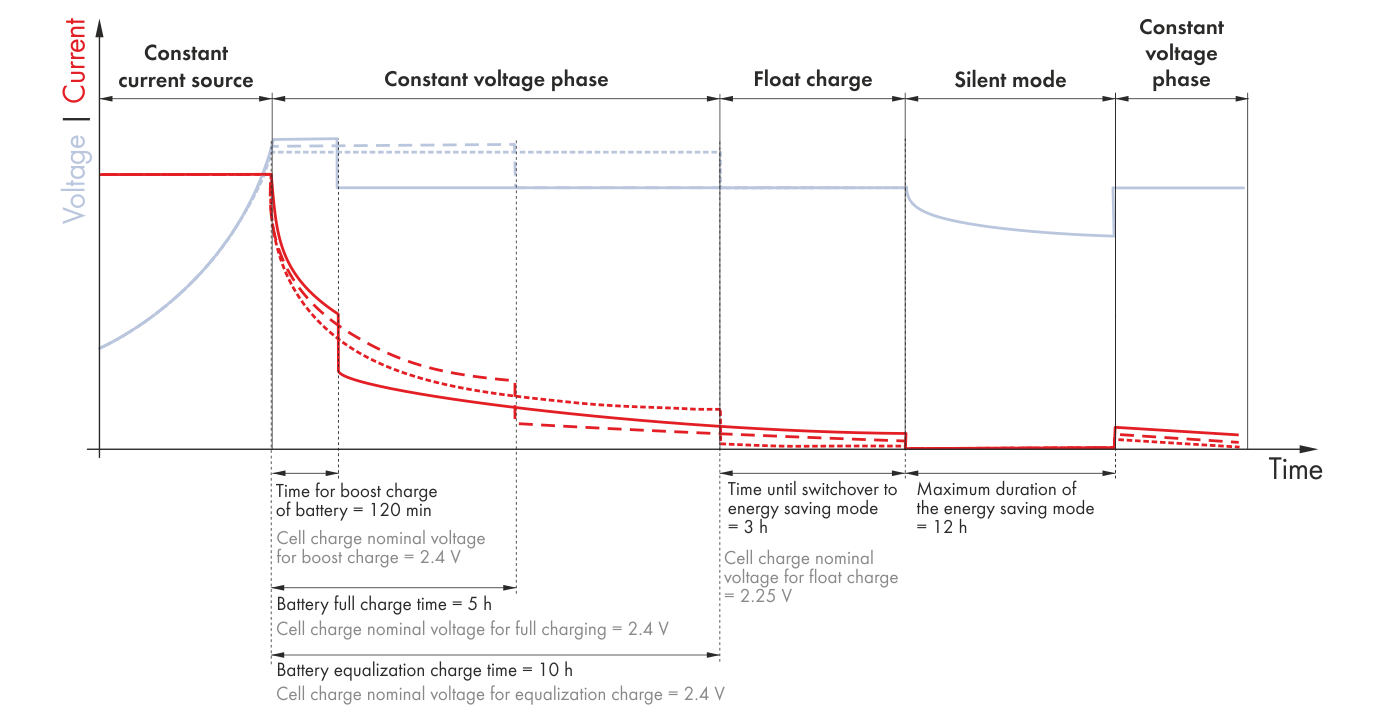
Sunny Island inverter charging phases with sample values for an AGM battery.
The Sunny Island regulates the charging of the battery in the following three phases:
Constant current phase (I phase / bulk phase)
Constant voltage phase (absorption phase / Vo phase)
Float charge phase (V phase)
When operating on the utility grid and Silent Mode is active, there is also a silent phase.
Constant current phase
During the constant current phase, the primary task of the battery management system is to limit the current to the maximum permissible battery current. The maximum charging current can be limited to the value specified by the battery manufacturer by changing the parameter Max. battery charging current. The battery charging current available is also limited by the following parameters:
Nominal currents of the external energy sources (parameters Maximum current from public grid and Rated generator current)
Maximum AC charging current of the Sunny Island inverter (parameter Maximum AC battery charge current)
The first value to be reached limits the battery charging current. While the charging current is maintained within the thresholds specified, the battery voltage increases as the battery is charged. The constant current phase ends when the cell voltage of the battery reaches the setpoint specified for the respective battery type.
Constant voltage phase
In the constant voltage phase, the battery voltage is kept at a constant value. As a result, the battery current decreases continuously. For the constant voltage phase, the battery management system selects one of the following three charging processes ( > Charging Processes):
Boost charge
Full charge
Equalization charge
For each of these three charging processes, you can adjust the voltage and charging time to the levels specified by the battery manufacturer in the Sunny Island. Once the specified charging time has been reached, the constant voltage phase ends and the Sunny Island switches to the float charge phase.
Float charge
The purpose of the float charge phase is to maintain the battery in a fully charged state without overcharging it. At the beginning of the float charge phase, the battery management system reduces the charging voltage in steps until the float charge setpoint specified has been reached. The battery management system then maintains this charging voltage until the end of the float charge phase. The float charge phase ends when one of the following conditions is met:
The sum of all battery discharges has reached 30% of the nominal capacity.
The current state of charge is less than 70% of the available charging capacity.
The battery management system switches from the float charge phase to the constant current phase. If the stand-alone grid is connected to the electricity grid, the battery management system can also switch from the float charge phase to silent mode.
Silent mode
In silent mode, the Sunny Island switches to standby, thus saving energy. Once the time set for the float charge (parameter Time until change-over to energy saving mode) expires in systems connected to the utility grid, the battery management system switches to silent mode and any connected loads are supplied exclusively from the utility grid. The Sunny Island leaves the silent mode in adjustable intervals (parameter Maximum duration of the energy saving mode) or when the battery voltage per cell drops by 0.14 V. This way, the battery always remains fully charged.