
Installation site and heat dissipation
The conversion of direct current into alternating current cannot take place without any losses. During the physical process heat is lost, for example, by being emitted via the inverter's enclosure design, e.g. via the heat sinks or actively through the use of fans, to protect the inverter from overheating. In simplified terms, the inverter efficiency reflects these losses as the ratio of input power to output power.
SMA inverters have cooling systems tailored to their power and design. Passively cooled inverters dissipate heat to the atmosphere through heat sinks.
Actively cooled devices with OptiCool systems have supplementary ventilation. As soon as the device generates more heat than its enclosure can dissipate, an internal fan switches on and draws in air through the cooling ducts of the enclosure. The fan is speed-controlled: it turns faster as the temperature rises. The advantage of active cooling is that the inverter can continue to feed in its maximum power as the temperature rises. The inverter is not derated until the cooling system reaches the limits of its capacity. Actively cooled inverters thus have extra power reserves compared to passively cooled devices.
You can avoid temperature derating by installing inverters in such a way that the heat is adequately dissipated:
Install inverters in cool locations, e.g. basements instead of attics.
Choose locations with sufficient air circulation. Install additional ventilation if needed.
Do not expose the inverter to direct solar irradiation. If you install an inverter outdoors, position it in the shade or install a roof overhead.
Maintain the minimum clearances from adjacent inverters or other objects, as specified in the installation manual. Increase the clearances if high temperatures are likely to occur at the installation site.
When installing several inverters, arrange them so that they do not draw in the warm exhaust air emitted by other inverters. Passively cooled inverters are offset so the heat from the heat sinks can escape upwards. The optimum arrangement for actively cooled inverters depends on the position of the air intake and exhaust openings.
Temperature derating
Temperature derating prevents the sensitive semiconductors in the inverter from overheating. Once the permissible temperature on the monitored components is reached, the inverter shifts its operating point to a reduced power level. The power is reduced in steps. In extreme cases, the inverter will shut down completely. As soon as the temperature of the sensitive components falls below a critical value again, the inverter returns to the optimum operating point.
The following graphic shows an example of the power output of a Sunny Highpower Power as a function of temperature:
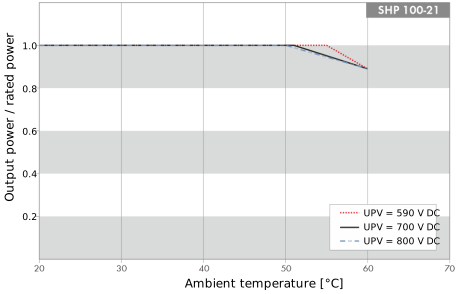
Additional information is available under the following link: Technical Information "Temperature Derating" and at www.SMA-Solar.com.
An overview of efficiencies and derating behavior of SMA inverters is available under the following link: Technical Information "Efficiencies and Derating" and at www.SMA-Solar.com.