
I-V diagnostic functions
With the diagnostic function for measuring the current/voltage characteristic curve (I-V characteristic curve) of the connected strings, the inverter can identify the characteristic curve of the generator. The measurement results can be visualized both as an I-V characteristic curve and as a power/voltage characteristic curve1) (P-V characteristic curve) ( > Interfaces and Functions).
If changes or deviations from the ideal curve occur, faults in the PV modules can be detected and documented at an early stage. This function can be used during system maintenance or fault diagnosis to extend the service portfolio of the installer through simple measures.
Each PV module and each module string has a typical current and voltage characteristic, which ideally corresponds to the following graphic curve:
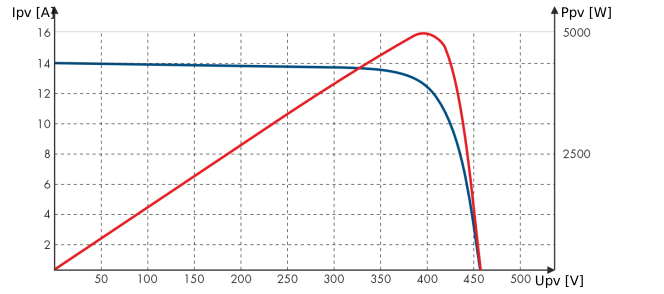
I-V characteristic curve (blue) and P-V characteristic curve (red)
For analysis, the string is operated at different operating points and the resulting current in each case is determined at different voltages.
The characteristic curve is limited by the open-circuit voltage and short-circuit current of the PV string. The respective inverter's MPP tracker (maximum power point tracker) is used to determine the characteristic curve. The MPP tracker already has the capabilities to calculate all the necessary data.
A difference to MPP operation during feed-in is a special measuring mode in which the I-V characteristic curve is measured per MPP tracker. The measurement can be performed via the local inverter user interface. This involves recording the I-V curve of the connected PV modules for each MPP tracker. The result is displayed in the user interface of the inverter as a graph and a table. The results can also be downloaded and saved as a CSV file or PDF file.
Based on deviations of the measured I-V curve shape from an ideal current and voltage characteristic curve or the observation of deviations of the I-V curve shape from previous measurements performed under similar ambient conditions, problems can be detected quickly and easily and investigated in more detail. This method is ideally suited for preventive checks during maintenance or fault diagnosis.
In addition to the graphic representation of the measurement results, a table is also displayed containing the most important characteristic data of the measurement.
Value | Description |
|---|---|
Vmpp | Voltage at maximum power |
Impp | Current at max. power |
Pmpp | Maximum power |
Voc | Open-circuit voltage |
Isc | Short-circuit current |
Fill factor | Characteristic value for the curve shape |
The fill factor provides information about the shape of the I-V characteristic curve. The higher the fill factor, the more the shape of the characteristic curve approaches a rectangle. For crystalline PV modules, values between 0.75 and 0.82 are reached. A fill factor significantly below this value at nominal conditions indicates potential faults that may result in a yield loss.
In addition to displaying the results on the user interface of the inverter, a PDF export or CSV export can also be generated to log the measurement. At the same time, a choice can be made as to whether the I-V characteristic curve or the P-V characteristic curve is documented.
Detailed information on how to perform the measurement and how to interpret the results can be found under the following link: Technical Information "I-V and P-V Diagnostics Function: Using the inverter to determine the generator's characteristic curve to detect faults in PV modules" and at www.SMA-Solar.com.
1) Availability depends on the inverter type and firmware version
Also see: