
Avoiding Unbalanced Load
Requirements of the "VDE Forum Network Technology / Network Operations (FNN)"
When using an SMA Energy System Home in Germany, the requirements regarding symmetry and monitoring of feed-in power must be implemented in accordance with the Technical Information "Connecting and Operating Storage Units in Low Voltage Networks" published by the FNN. Current information and manufacturer declarations can be found at www.SMA-Solar.com in the download area. Requirements:
In these systems, the single-phase battery inverter must be connected to the same line conductor supplied by a single-phase PV inverter. If there are only three-phase PV inverters connected, the battery inverter can be connected to any line conductor.
Single-phase generating means, storage and charging devices must always be connected to a common line conductor. When connecting several charging stations, ensure that line conductor L1 is evenly distributed over the three line conductors.
The requirements of the technical information "Connection and Operation of Storage Units in Low-Voltage Networks" published by the FNN influence the discharge behavior of the battery inverter. When using systems with one battery inverter and single-phase PV inverter, the feed-in power of all inverters (minus the power of the load) must not exceed 4.6 kVA per phase. That is why the SMA storage system reduces the maximum discharge power of the battery inverter as required.
Examples for the implementation
In the following illustrations, the Sunny Island is shown as an example for battery inverters. The Sunny Boy Storage must be connected according to the same principles.
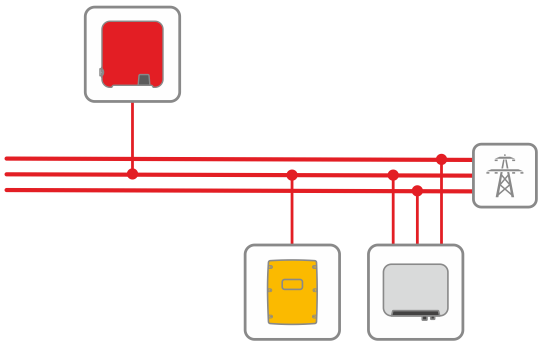
Example 1: All PV inverters are single-phase and are feeding in asymmetrically (Sunny Boy). The PV inverters are connected to one line conductor. In these systems, the single-phase battery inverter must be connected to the same line conductor in which the PV inverters feed into. The charging station (SMA EV Charger) must be connected with L1 to the same line conductor in which the PV inverters feed into. |
|
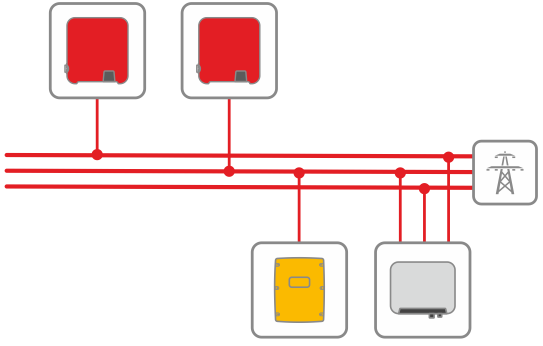
Example 2: All PV inverters are single-phase and are feeding in asymmetrically (Sunny Boy). PV inverters are connected to two line conductors. The single-phase battery inverter must be connected to a line conductor via a single-phase PV inverter. TIP: Connect the battery inverter to the line conductor being supplied with the least PV energy. This will increase the control range for increased self-consumption. The charging station must be connected with L1 to the same line conductor to which the battery inverter is connected. |
|
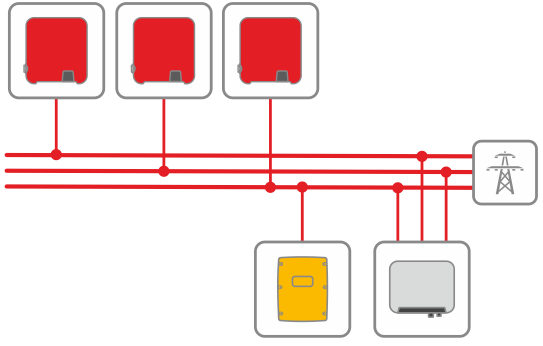
Example 3: All PV inverters are single-phase and are feeding in asymmetrically (Sunny Boy). One PV inverter is connected to each line conductor. The single-phase battery inverter can be connected to any line conductor. TIP: Connect the battery inverter to the line conductor being supplied with the least PV energy. This will increase the control range for increased self-consumption. The charging station must be connected with L1 to the same line conductor to which the battery inverter is connected. |
|
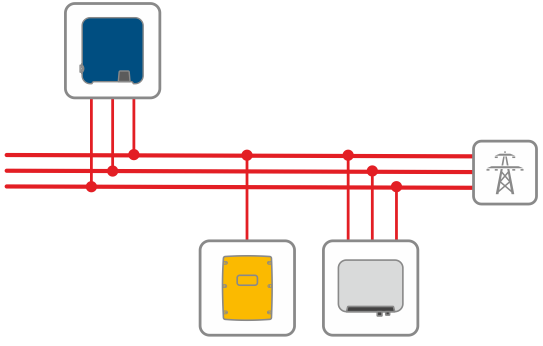
Example 4: All PV inverters are three-phase and are feeding in symmetrically (Sunny Tripower). The single-phase battery inverter can be connected to any line conductor. The charging station must be connected with L1 to the same line conductor to which the battery inverter is connected. |
|
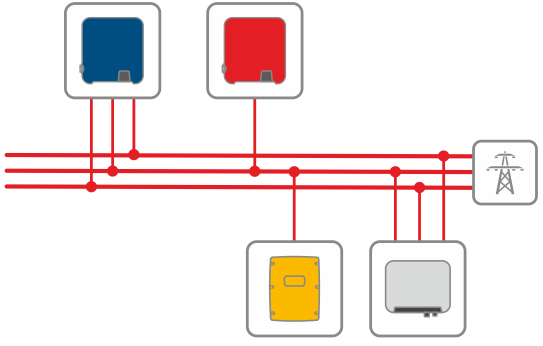
Example 5: The PV system consists of three-phase PV inverters (Sunny Tripower) and single-phase PV inverters (Sunny Boy). The PV system is feeding in asymmetrically. The single-phase battery inverter must be connected to a line conductor via a single-phase PV inverter. IMPORTANT: The battery inverter can only discharge the battery if less than 4.6 kVA are being fed in on the line conductor of the battery inverter at the point of common coupling. The charging station must be connected with L1 to the same line conductor in which the single-phase PV inverters feed into. |
|

Using the Sunny Home Manager or SMA Energy Meter
For the single-phase SMA storage system to be able to monitor the limitation of the feed-in power, the Sunny Home Manager 2.0 or the SMA Energy Meter must be used. Only these two devices provide the phase-specific measured values of the feed-in power that are required for the limitation to 4.6 kVA.
The Sunny Home Manager 2.0 or the SMA Energy Meter must also be used for three-phase PV inverters in the single-phase or in the three-phase storage system since only these devices supply the measured values at the required level of breakdown.