
Example of Avoiding Derating Losses with Forecast-Based Battery Charging
With the SMA Energy System Home, you can choose between an economically optimized mode of operation (activation of the forecast-based battery charging) and an optimized mode of operation with regard to the self-sufficiency (no activation of the forecast-based battery charging).
The advantages and disadvantages of forecast-based battery charging using an example are considered in this Section. We assume a limitation of the feed-in power of 60%.
Input data:
Peak power of the PV system: 5000 Wp
Annual energy demand: 5000 kWh
Total battery capacity: 10000 Wh, of which the Sunny Island uses 50% for intermediate storage of the PV energy.
The usable battery capacity therefore amounts to 5000 Wh.
The following figure illustrates the percentage derating losses with and without forecast-based battery charging:
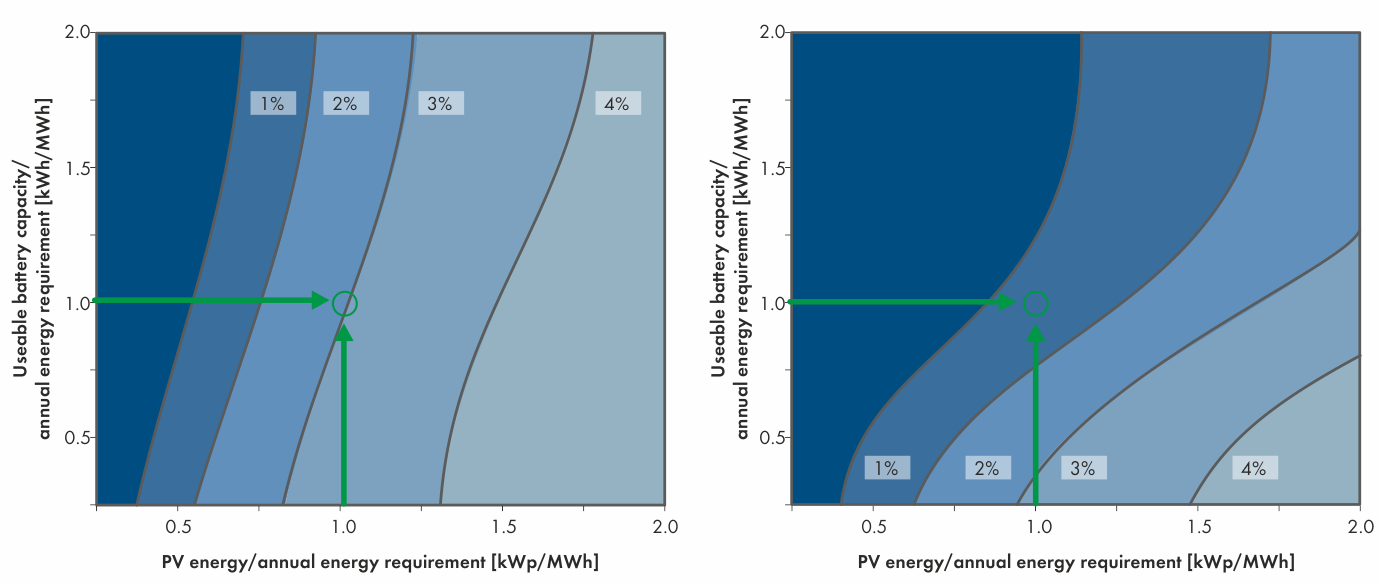
Annual percentage losses based on the PV generation with limitation of grid feed-in to 60% – without (A) and with (B) forecast-based battery charging
If we assume a PV generation of 4500 kWh per year for a PV system with a power of 5 kWp, we see the following results:
With fixed active power feed-in limitation, 315 kWh of the generated PV energy is derated – this equals 7% of 4500 kWh (the value of 7% applies for all configurations)
Without forecast-based battery charging, 135 kWh of the generated PV energy is derated - this equals 3% of 4500 kWh (see part A in the figure above)
With forecast-based battery charging, only 67 kWh of the generated PV energy is derated - this equals 1.5% of 4500 kWh (see part B in the figure above)
Through forecast-based battery charging, we could thus intermediately store 68 kWh of PV energy (135 kWh ‒ 67 kWh) in the battery and use it to supply the household instead of having it derated. By shifting the charging operation from morning to noon, the PV system could also feed in more during the morning.
Conclusion:
If we compare the options with and without forecast-based battery charging, the forecast-based battery charging results in a positive financial effect in most cases. However, it is possible that the forecasts are not correct. As a result, the battery may be used less which can lead to lower self-sufficiency quotas.