
Distinguishing Between Self-Consumption Systems and Feed-In Systems in SMA Smart Home
In the system properties in Sunny Portal, you can set the system type for the relevant system. There are two system types:
Self-consumption system
Feed-in system
Self-consumption system
The objective in a self-consumption system is to consume as much of the generated PV energy oneself as possible. This works best if the loads in the household are switched on whenever the sun is shining and the PV system is generating a lot of electricity.
The Sunny Home Manager uses its intelligent energy management to ensure that the controllable loads are switched on automatically when there is sufficient PV energy available.
Self-consumption systems are attractive whenever the feed-in tariff for PV energy is significantly below the purchase cost of grid current. Therefore, high self-consumption contributes to lowering the energy costs.
The energy meters must be installed in such a way that the household loads can consume the PV energy before the feed-in or grid-connection point. Then only the surplus PV energy is fed into the utility grid.
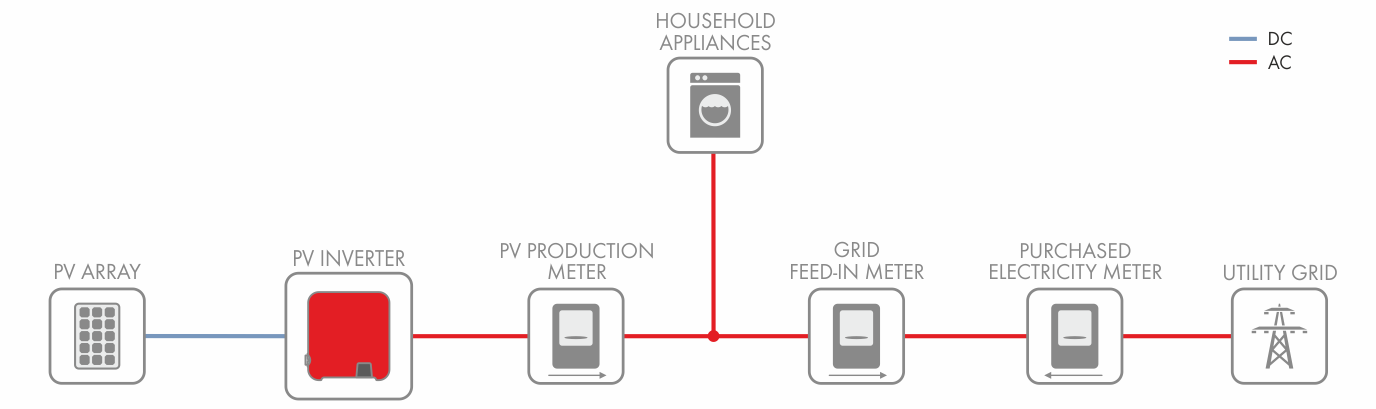
Energy meter installation in a self-consumption system (example)
Feed-in system
The objective of a feed-in system is to feed all the generated PV energy into the utility grid in order to receive the relevant feed-in tariff.
Feeding in of generated PV energy is attractive whenever the feed-in tariff is significantly above the purchase cost of grid current. In this case, the grid feed-in of PV energy is an attractive source of income for the PV system operator. Energy management for such systems is of limited value.
The energy meter must be installed in such a way that the household loads do not consume the PV energy directly:
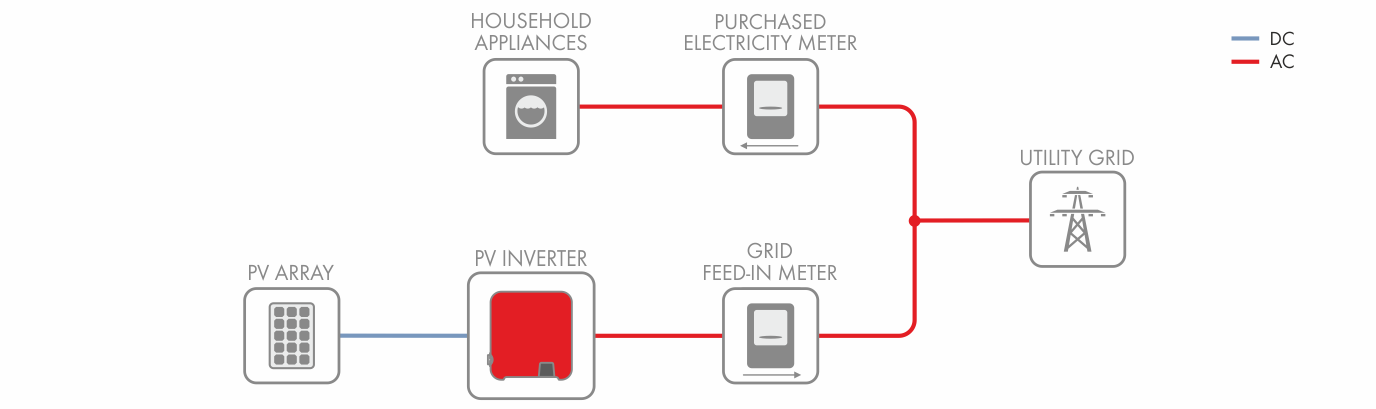
Energy meter installation in a feed-in system (example)

Restriction with feed-in systems with Sunny Home Manager
In feed-in systems with Sunny Home Manager, you cannot configure a CAN time period in Sunny Portal for load control.