
Avoiding Derating Losses Through Forecast-Based Battery Charging in SMA Storage Solutions
On days with strong sunshine around noon, a large portion of the available PV power may have to be derated to limit the active power feed-in due to local requirements. The Sunny Home Manager energy management already ensures that, especially on such days the controllable loads in the household are switched on exactly at those times in order to consume the energy that would otherwise be derated.
In addition, the energy from the noon peak can also be stored in the battery of the battery inverter. This is particularly effective since the stored energy can then be used when required at a later time.
Surplus of generated PV energy
Battery inverters draw power to charge the battery from a surplus of generated PV energy. This means that, before PV energy is fed into the utility grid, the system first attempts to use the energy to charge the battery. On days with strong sunshine, there may be a surplus of PV energy in the morning and the battery may even be fully charged before the noon peak. In this case, limitation of the PV feed-in is necessary at noon as the battery can no longer use the surplus PV energy.
This curtailment is avoided during forecast-based battery charging. Based on a PV power generation forecast and load planning, it is being forecast whether derating losses are expected at noon of the following day due to the limitation of PV feed-in. Already in the afternoon of the current day or in the morning of the next day, only the amount of energy is fed into the battery to absorb the forecast derating losses with the remaining battery capacity. This way, sufficient battery capacity will remain for the noon period so that the energy, which would otherwise be derated, can be charged to the battery. As a result, more PV energy is used and the electricity consumption is reduced due to the load shift.
SMA Energy System Home with Sunny Island, Sunny Boy Storage or Sunny Tripower Smart Energy
In Sunny Portal, in the device properties of the Sunny Home Manager, you can activate the optimized storage management for the Sunny Island, Sunny Boy Storage or the Sunny Tripower Smart Energy. This setting is deactivated by default. When the forecast-based battery charging is activated, the Sunny Home Manager can ensure a forecast-based battery charge through triggering of the battery inverter or hybrid inverter ( > Example of Avoiding Derating Losses with Forecast-Based Battery Charging).
Together with the Sunny Home Manager, an inverter-internal generated forecast regarding a probable curtailment during the noon peak brings about delayed charging of the battery during the morning. If the active power feed-in limitation is set to 100%, this optimization is practically deactivated.
Examples of power control with the SMA Energy System Home with storage solution
Below, the power control of the SMA Energy System Home with the Sunny Tripower Smart Energy is illustrated by way of examples from Sunny Portal.
Example 1: Avoiding derating losses through forecast-dependent charging
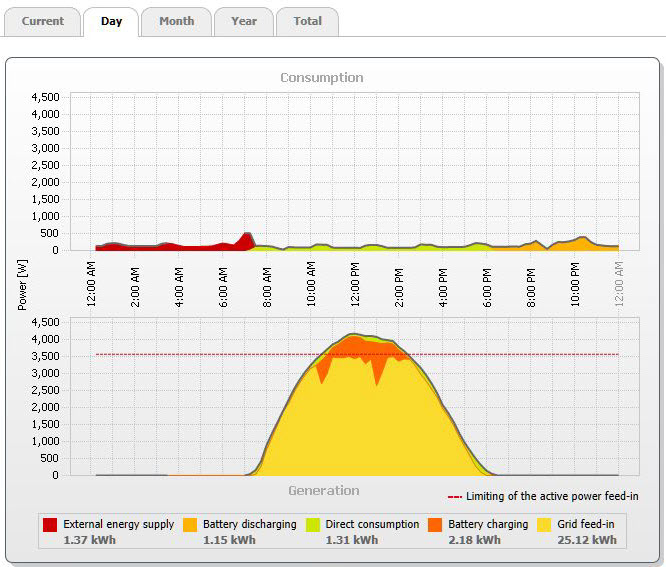
Consideration of PV generation and consumption in Sunny Portal (example 1)
The current daily forecast of the system predicts a limitation of active power feed-in around noon when the energy requirement of the loads is very low and PV production is high. For this reason, derating losses can be expected.
According to this forecast, the system only begins to charge the battery in the late morning. The derating losses are almost completely avoided through battery charging.
Example 2: Avoiding derating losses through direct consumption and battery charging
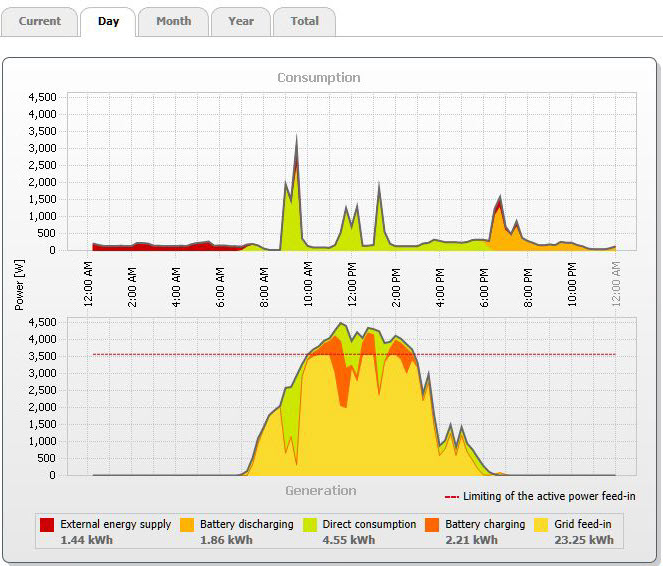
Consideration of PV generation and consumption in Sunny Portal (example 2)
As in example 1, the current daily forecast anticipates limitation of the active power feed-in around noon. In this case, however, the loads have a slightly higher energy demand. To avoid derating losses, therefore, the SMA storage system schedules direct consumption and intermediate storage for the midday period.
According to its forecast, the system only begins to charge the battery in the late morning. The derating losses are avoided through direct consumption and battery charging.
Example 3: Avoiding derating losses through direct consumption
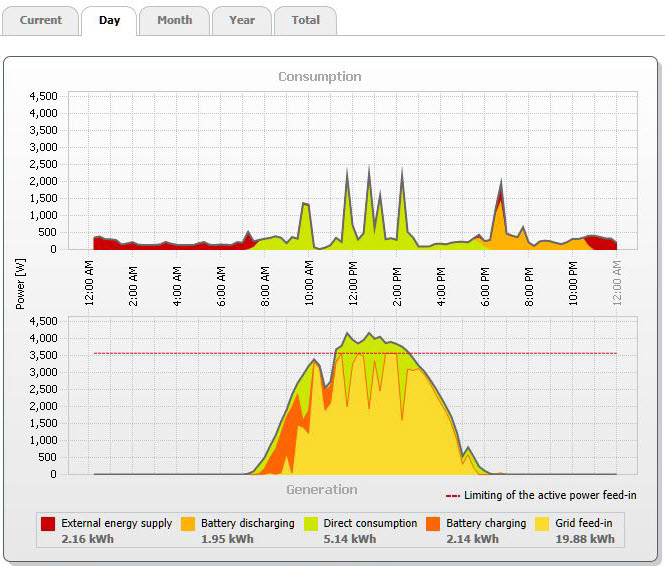
Consideration of PV generation and consumption in Sunny Portal (example 3)
As in examples 1 and 2, the current daily forecast anticipates limitation of the active power feed-in around noon. In this case, however, the loads have a much higher energy demand. The expected derating losses are therefore avoided completely through direct consumption.
The system, therefore, fully charges the battery during the morning and, in this example, avoids derating losses exclusively through direct consumption, for example, through intelligent load control.
Example 4: No forecast for derating losses
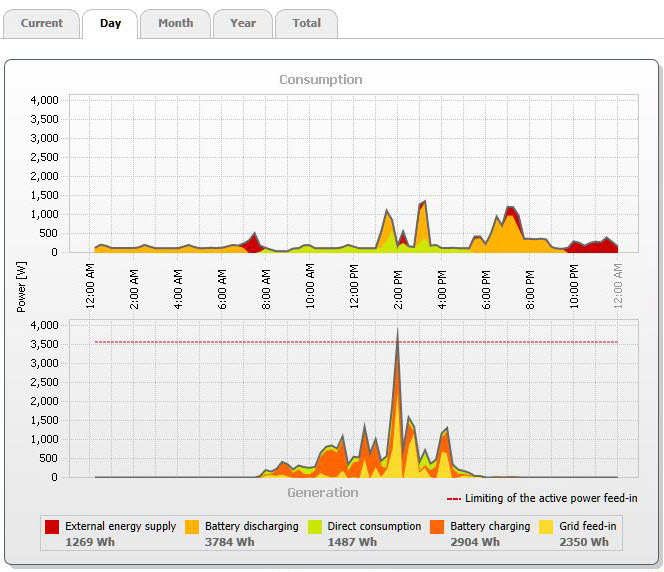
Consideration of PV generation and consumption in Sunny Portal (example 4)
If no limitation of active power feed-in is forecast for the current day, the SMA Integrated Storage System works in accordance with the general power control ( > General Power Control).