
Battery Use by the Sunny Island
In many regions, the PV energy available largely depends on the season and the hours of sunshine. The discharge behavior can be adjusted to the location and time by the Sunny Island.
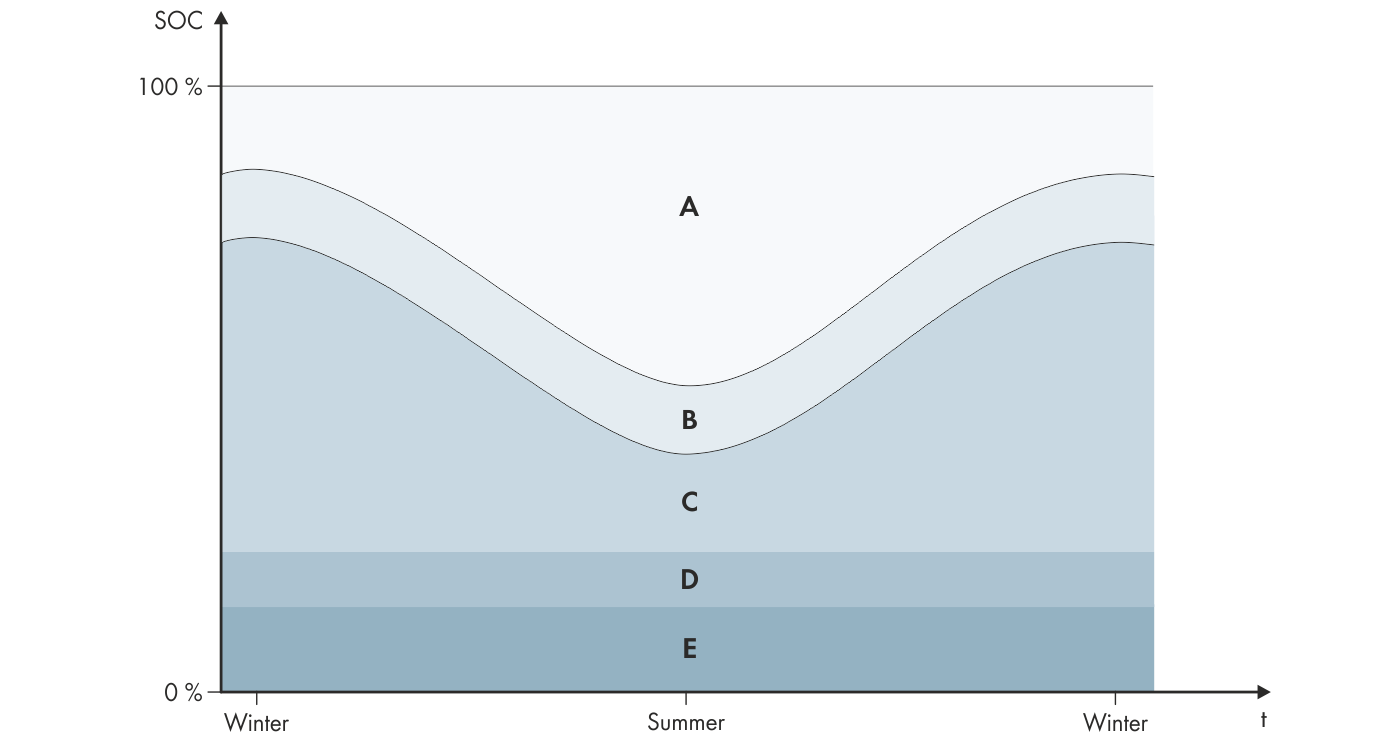
Ranges of the battery state of charge as a function of the season for the northern hemisphere (example)
Position | Range | Explanation |
|---|---|---|
A | Self-consumption area (SlfCsmp) | Range for intermediate storage |
B | State of charge conservation area (PVRes) | Range for maintenance of the battery state of charge |
C | Backup power area (BURes) | Range for battery-backup function |
D | Deep discharge protection area (BatRes) | Range for protection against deep discharge |
E | Deep discharge area (ProtRes) | Range for protection in the event of deep discharge |
Due to the seasonal battery operation of the Sunny Island, a larger range is reserved for the battery backup function in winter than in summer. This makes sense, as consumption in summer is lower and the PV yield is also much higher in summer. The limits for the ranges of battery state of charge are predetermined for lead-acid batteries and lithium-ion batteries by the following value ranges of the Sunny Island inverter.
Range | Lead-acid battery | Lithium-ion battery | ||
|---|---|---|---|---|
Shortest day1) | Longest day2) | Shortest day1) | Longest day2) | |
Self-consumption range | 65% to 100% | 45% to 100% | 30% to 100% | 28% to 100% |
State of charge conservation range | 60% to 65% | 40% to 45% | 25% to 30% | 23% to 28% |
Backup power range | 15% to 60% | 15% to 40% | 13% to 25% | 13% to 23% |
Deep discharge protection range | 10% to 15% | 10% to 15% | 3% to 13% | 3% to 13% |
Deep discharge range | 0% to 10% | 0% to 10% | 0% to 3% | 0% to 3% |
1) December 21 (northern hemisphere) or June 21 (southern hemisphere)
2) June 21 (northern hemisphere) or December 21 (southern hemisphere)
1) December 21 (northern hemisphere) or June 21 (southern hemisphere)
2) June 21 (northern hemisphere) or December 21 (southern hemisphere)
The value ranges for lithium-ion batteries reserve a smaller proportion of battery capacity for the battery-backup function: 10% of battery capacity in summer and 12% of battery capacity in winter. Therefore, the proportion available for intermediate storage is correspondingly larger.