
Design and Function of a Battery-Backup System
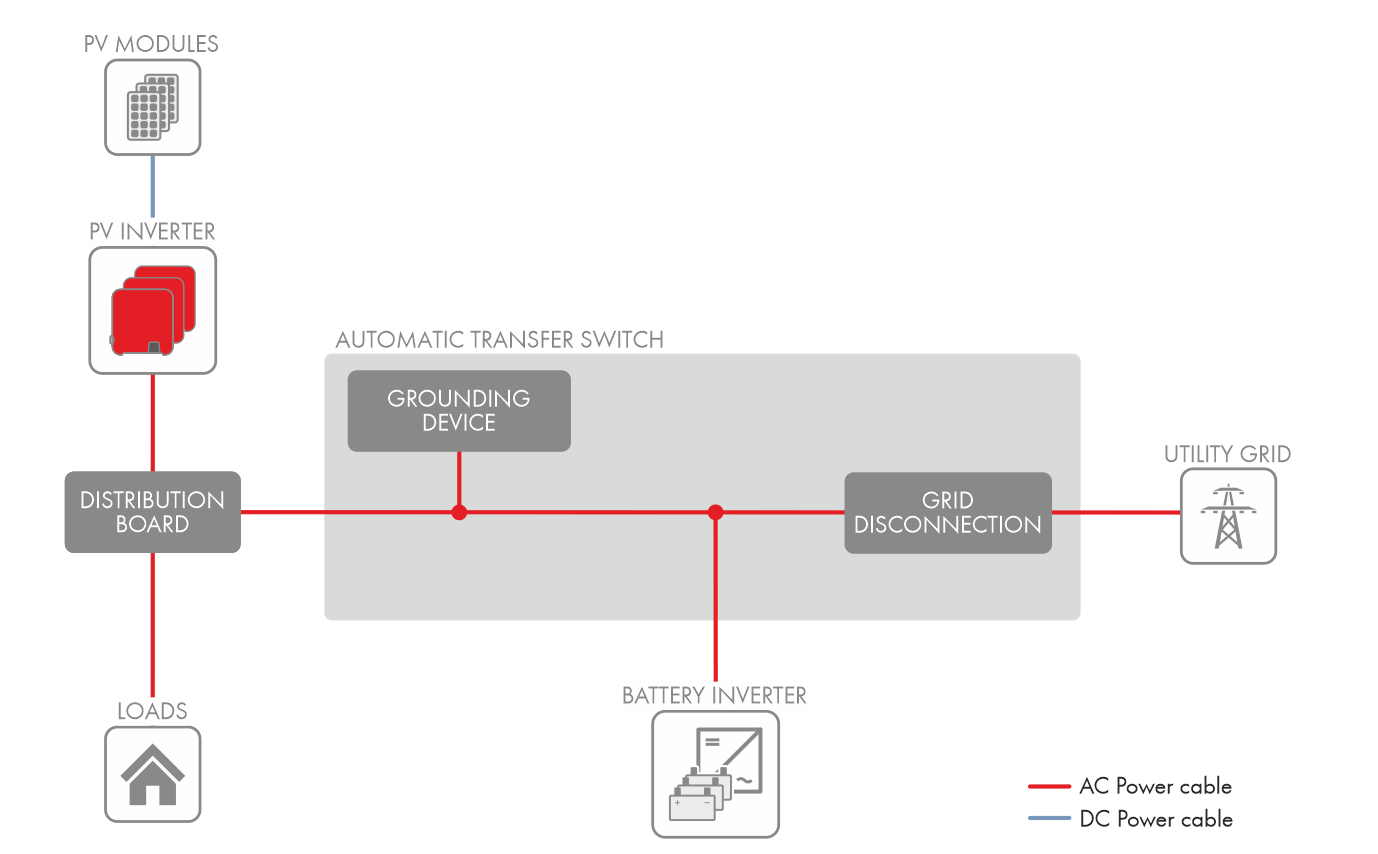
Basic design of a battery-backup system with battery inverter and PV inverter
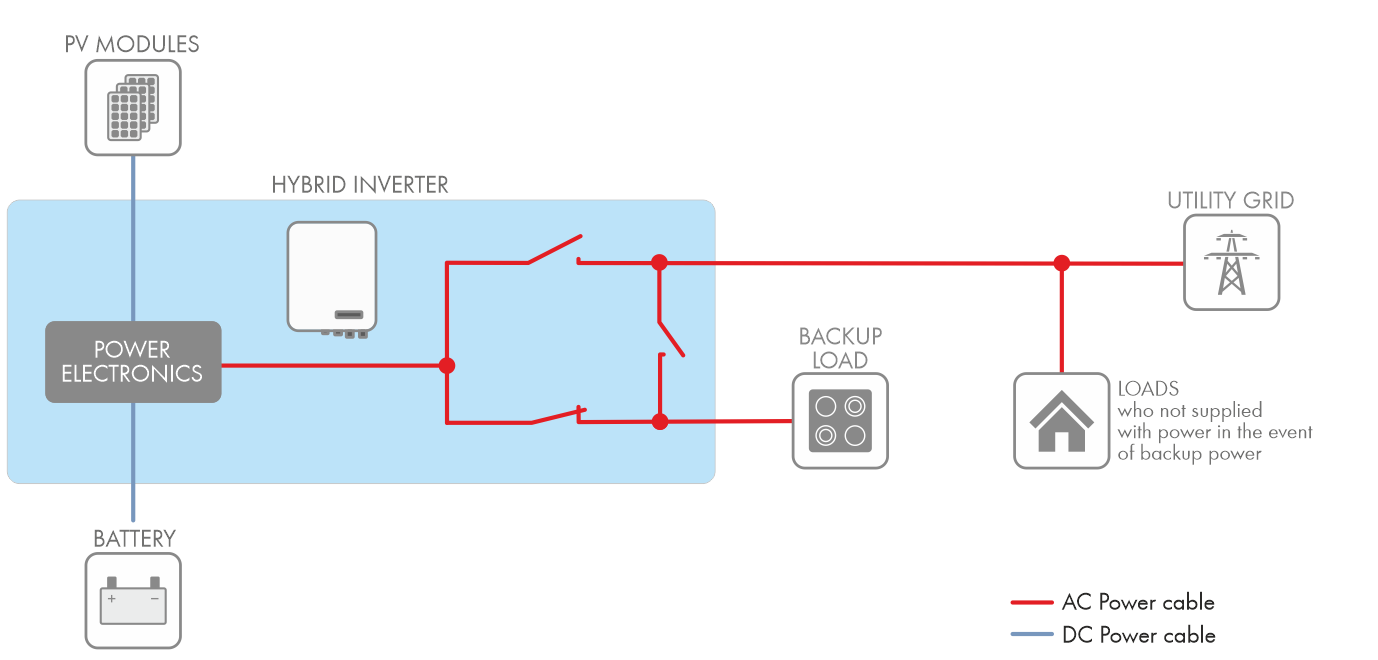
Basic design of a battery-backup system with hybrid inverter in the event of a grid failure
Components of the SMA Home Energy Solution with Battery-Backup Function
|
Component |
Function |
|---|---|
Battery inverter or hybrid inverter | In the event of grid failure, the battery inverter or hybrid inverter forms a battery-backup grid and regulates the energy distribution in this battery-backup grid. In parallel grid operation, the battery inverter or hybrid inverter is responsible for the optimization of self-consumption or energy self-sufficiency. The following battery inverters are used in battery-backup systems:
The following hybrid inverters are used in battery-backup systems:
In a three-phase household grid, a single-phase battery inverter can only be connected to one line conductor and thus only monitor one line conductor for a grid failure. When the grid failure happens, all line conductors of the household grid, however, are disconnected from the utility grid. |
|
Battery (not shown graphically) |
The battery stores excess energy from the PV system. In parallel grid operation, this buffered PV energy is used to optimize self-consumption or internal power supply, and in the event of grid failure, it is used for supplying the loads. |
|
Battery fuse (not shown graphically) |
When using the Sunny Island with lead-acid batteries, a battery fuse must be installed. As an external DC fuse, the battery fuse safeguards the battery connection lines of the battery inverter. Furthermore, the battery fuse enables DC-side disconnection of the battery inverter. Lithium-ion batteries do not usually need an external battery fuse (see manufacturer documentation). |
Devices of the automatic transfer switching device

The automatic transfer switching device is integrated into the Sunny Tripower Smart Energy and does not have to be installed additionally.
The structure of the automatic transfer switching device depends on the country-specific requirements. That is why only the most important components of an automatic transfer switching device are described in the following.
|
Component |
Function |
|---|---|
|
Grid disconnection |
The functional group grid disconnection is part of the automatic transfer switch of the battery-backup system and disconnects the battery-backup grid from the utility grid in the event of grid failure. |
|
Grounding device |
In the case of all-pole disconnection, the functional group grounding device is part of the automatic transfer switch of the battery-backup system and enables protection against indirect contact with live components. For this, the grounding device connects the neutral conductor and the protective grounding in stand-alone mode (neutral grounding). |
Phase coupling (not shown graphically) | The phase coupling is an optional function for a single-phase battery-backup system that is connected to a three-phase household grid. With single-phase battery-backup systems, only one single-phase battery inverter or hybrid inverter is connected to the automatic transfer switching device. Therefore, in the event of grid disconnection, without phase coupling only one line conductor (e.g. L1) of the household grid is protected against grid failure. In this case, the other two line conductors (e.g. L2 and L3) cannot be protected. Phase coupling enables combined switching of the line conductors in the event of grid disconnection. As a result, the other two line conductors are also supplied with voltage. This means that, in the event of grid failure, a three-phase utility grid becomes a single-phase utility grid. Phase coupling can be switched on independently for the line conductors L2 und L3. |